
Nov 29
/
Fernando Rebello
Understanding the Placenta Layer in Syntropic Agroforestry
What if a handful of short-lived plants could act as a living nursery for an entire forest? In syntropic agroforestry, Ernst Götsch’s concept of the “placenta” does exactly that: a deliberately selected layer of fast-growing plants that protects, feeds and accelerates the growth of young trees. This short primer explains the idea, teases a few practical benefits, and points you to a full course where you can learn step-by-step implementation.
What the placenta is — in one paragraph
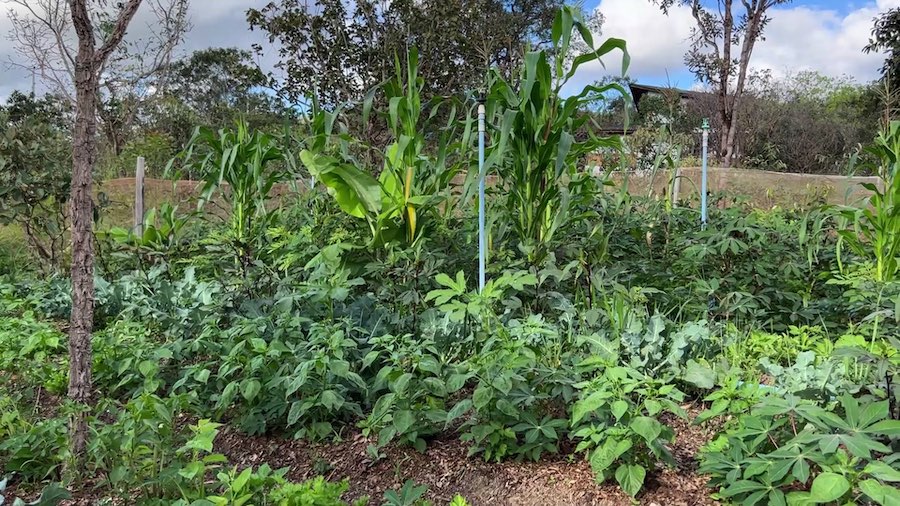
The placenta is the temporary skin of a newly established agroforest: short-lived species (from quick vegetables to fast legumes and biomass producers) that dominate for the first months up to about two years. They’re the system’s nurse plants — covering soil, producing large amounts of biomass, and creating favorable microclimates for tree seedlings. Think of them as intentional pioneers that give the forest its best start.
Why it matters
- Fast protection: Rapid ground cover reduces erosion, conserves moisture, and suppresses weeds from day one.
- Biomass and fertility: Frequent pruning of placenta species creates mulch and feeds soil life, accelerating nutrient cycling.
- Growth signalling: Pruning stimulates growth hormones that benefit adjacent trees, speeding establishment.
- Income potential: Use marketable vegetables as placenta to finance planting and maintenance in the short term.
- Labor efficiency: A well-chosen placenta reduces selective weeding and establishes a more resilient system faster.
A few practical teasers
- Species choices matter: short-lived vegetables suit systems where short-term income is needed; aggressive biomass plants like Tithonia or fast legumes are better when the priority is rapid soil-building.
- Prune to extend life: Some fast plants can be kept vegetative (and productive) by removing flower buds and pruning—this both creates mulch and prolongs their nurse role.
- Mind the density: The placenta should nurse, not smother. Overprotecting tree seedlings by planting nurse plants too densely can limit tree development—balance is essential.
Real-world glimpses
- Vegetables-as-nurse: Rows of young trees with vegetable beds between them can finance the early years and provide steady soil cover until longer-lived placenta plants take over.
- Biomass-driven system: In other plots, a fast biomass producer is pruned repeatedly each month, piling mulch at tree bases and spurring tree growth through repeated growth pulses.
Why this short guide isn’t enough
The placenta concept is deceptively simple but richly contextual. Soil type, climate, crop markets, and desired forest composition all change the best choices. Implementation requires timing, pruning technique, and species mixes tuned to your site—details covered in guided courses and field demonstrations.
Learn the full method
If this primer sparked your curiosity, the full "Syntropic Glossary: Fundamentals and Key Terms" course at the F4F Academy expands on the placenta idea with classroom lessons and field examples, showing how to choose species, schedule pruning, manage succession, and measure results. Practical, field-tested, and designed for growers, the course is where the theory becomes an actionable system.
Explore the complete course and enroll here: https://academy.forests4farming.org/course/syntropic-glossary-fundamentals-and-key-terms
The placenta is a powerful shortcut to healthier, faster-establishing agroforests — but only when applied with site knowledge and timing. If you want hands-on instruction, templates for species mixes, and real-world case studies, the F4F Academy course will take you from curious to confident.
Author note
This short post is a teaser based on an F4F Academy lecture. For step-by-step guidance, examples and course enrollment, visit the link above.
Write your awesome label here.
Write your awesome label here.
Write your awesome label here.
Write your awesome label here.

Copyright © 2026 Forests4Farming. All rights reserved.
SyntroPedia is live!
A comprehensive plant encyclopedia for Syntropic Agroforestry. Free and 100% offline. Learn, plan, and grow smarter ecosystems.